- How do Google AI Overviews and ChatGPT search change the way customers in Egypt and Saudi Arabia find a brand?
- What should a marketing team actually do about generative engine optimization — and what is just hype?
- Which technical and content foundations decide whether an AI answer cites your pages?
Search is becoming an answer, not a list
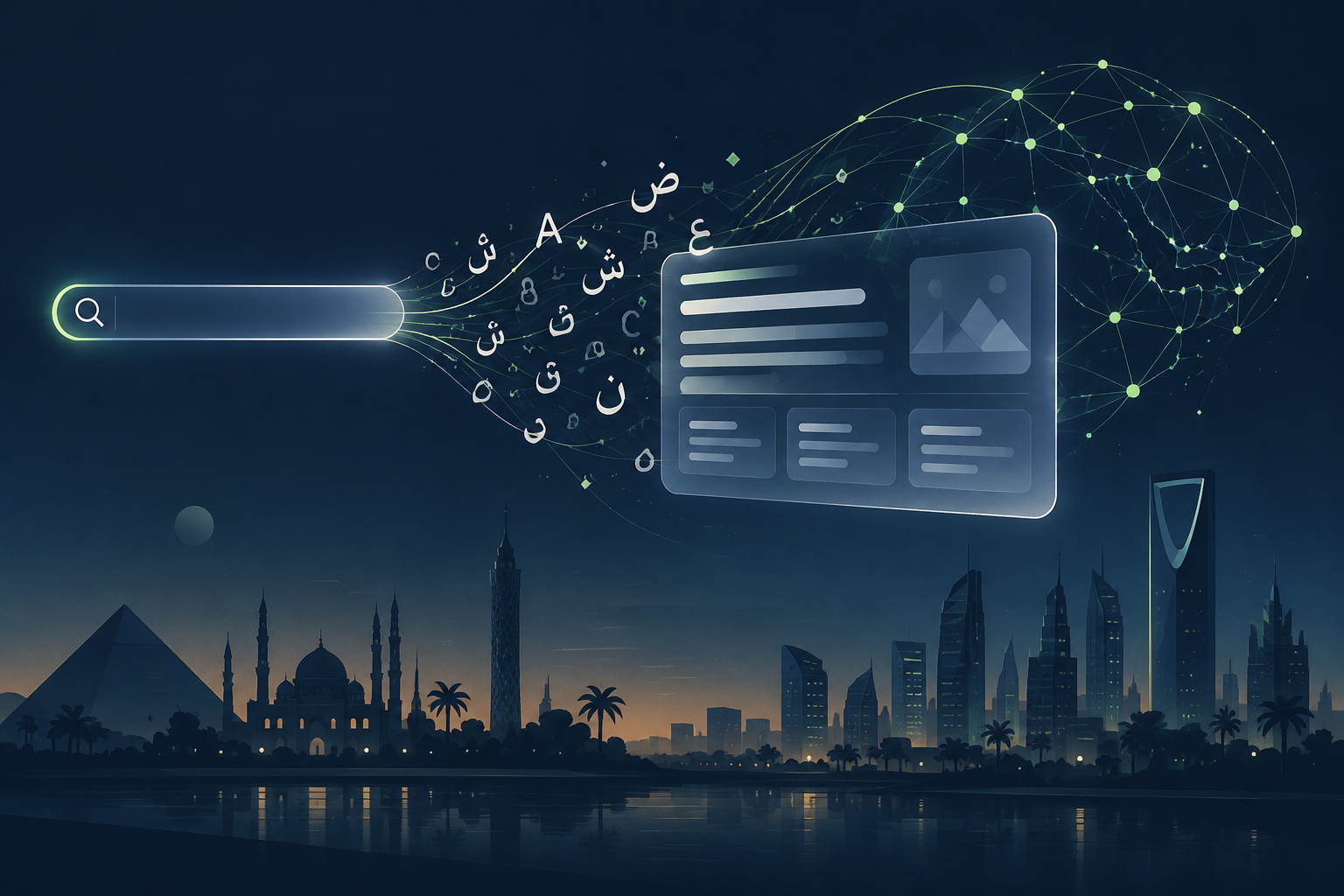
For twenty years, search marketing meant competing for a position in a list of blue links. That model is changing. Google's AI Overviews now place a generated summary above the classic results for many queries, and ChatGPT search answers questions directly, with cited sources, inside a conversation. For a brand in Cairo or Riyadh, the practical consequence is simple: a growing share of your potential customers will read an AI-generated answer before they ever see your website — and some will never click through at all.
This is not a reason to panic, and it is not a reason to abandon SEO. Google's own guidance is explicit: the same fundamentals that make a page rank well in classic search are what make it eligible to appear in AI features. There is no separate "AI ranking" you can buy or hack. What changes is the bar: thin, generic, me-too content that used to survive on page two now has no reason to be cited at all.
What generative engine optimization actually means
"Generative engine optimization" (GEO) is the industry term for making your content visible, citable and correctly represented inside AI-generated answers. Strip away the buzzword and it reduces to four disciplines:
- Being findable. AI answers are built from pages search engines can crawl, index and understand. If your technical SEO is broken, nothing else matters.
- Being quotable. AI systems extract passages. Content that answers a specific question clearly, in a self-contained paragraph, is far easier to cite than content that buries the answer under introductions and filler.
- Being trustworthy. AI features prefer sources that demonstrate first-hand expertise, clear authorship and accurate, verifiable claims — the same E-E-A-T signals Google has described for years.
- Being consistent. AI models reconcile what your website says with what reviews, directories, social profiles and media say about you. Contradictions erode confidence in citing you.
None of this replaces classic SEO. It raises the standard for it.
The foundations that decide whether AI cites you
Technical access and structure
Google's documentation on AI features confirms that standard Search controls apply: if a page is indexable and eligible for a snippet, it can appear in AI Overviews; nosnippet and noindex directives remove it. That means the checklist starts with the unglamorous work — crawlability, canonical URLs, mobile rendering, page speed and correct hreflang for your Arabic and English versions. A bilingual MENA site with broken hreflang is telling AI systems two contradictory stories about itself.
Structured data matters here too, with an honest caveat: schema markup does not guarantee inclusion in AI answers, but it removes ambiguity about what a page is — an article, a service, an organization, an FAQ. Ambiguity is the enemy of citation.
Content built around real questions
AI search is conversational. People ask ChatGPT and Google's AI mode full questions: "Which agency can run Arabic TikTok campaigns in Riyadh?" rather than "tiktok agency riyadh". Content that mirrors this — a clear question, a direct two-or-three sentence answer, then depth for those who want it — is structurally easier for an AI to lift and cite. This is why every Kitely article opens with the questions it answers.
For MENA brands there is a second layer: Arabic content. Arabic-language answers in AI tools are only as good as the Arabic sources available. Brands that publish substantive, well-structured Arabic content — not machine-translated afterthoughts — face far less competition for Arabic AI citations than they do in English.
Reputation beyond your own site
AI answers about "the best X in Y" are assembled from the whole web: reviews, directories, comparison articles, community forums, your own site. You cannot optimize your way around a weak off-site reputation. Accurate Google Business Profile data, consistent directory listings, genuine reviews and earned mentions in credible publications all feed the machine that decides whether your brand is mentioned at all.
A working checklist for the next quarter
Run this against your five most commercially important pages:
- Crawl and index check. Confirm each page is indexed, canonical and free of accidental
noindexor snippet-blocking directives. - Answer test. For each page, write the one question a buyer would ask an AI assistant that this page should answer. Does the page answer it directly, in the first paragraph of a section, in plain language?
- Bilingual parity. Does the Arabic version carry the same substance, structure and facts as the English one — or is it a thinner translation?
- Structured data. Does each page declare what it is (Article, Service, Organization) with valid schema?
- Evidence audit. Every claim on the page — results, clients, certifications — should trace to something verifiable. AI systems increasingly cross-check claims against the rest of the web.
- Off-site consistency. Search your brand name in an AI assistant. Is the description accurate? If not, the fix is usually off-site: outdated directories, stale profiles, missing reviews.
Mistakes to avoid
- Chasing "AI SEO hacks." Services promising guaranteed placement in ChatGPT answers are selling something that does not exist. No agency controls what an AI model cites.
- Publishing AI-generated filler at scale. Flooding your blog with unreviewed generated text is the fastest way to become exactly the kind of source AI systems are trained to distrust.
- Blocking AI crawlers out of fear, then wondering why you are invisible. Decide deliberately which bots you allow, with a reason for each.
- Treating Arabic as an afterthought. The Arabic opportunity in AI search is real precisely because so few brands invest in it.
- Measuring the wrong thing. AI answers reduce clicks for informational queries. Track whether your brand is mentioned and cited for the queries that matter, not only whether sessions grew.
Where this leaves a MENA brand
The brands that win AI search visibility will not be the ones that found a trick. They will be the ones with technically sound bilingual websites, content that genuinely answers buyer questions, and a reputation consistent enough that an AI system can cite them with confidence. That is a strategy and execution problem — exactly the gap Kitely exists to bridge.
If you want an honest read on how your brand currently appears in AI answers — and a prioritized plan to improve it — talk to Kitely. For the measurement side, see our guide to building an actionable marketing dashboard.