- What should a TikTok creative test help your team learn?
- How can separating the hook from the proof make comparisons more useful?
Test an explanation, not a pile of videos
TikTok ad testing in Saudi Arabia becomes more useful when every comparison answers a specific question. Uploading several unrelated videos can reveal a preferred execution, but it rarely explains whether the hook, demonstration, offer, or destination caused the difference. Start with the uncertainty that matters to the business.
For example: do buyers need to see the product working before they understand its value, or do they first need the problem stated clearly? That question can guide a controlled creative comparison. It also prevents production from becoming an endless search for novelty without a decision to make.
Write the hypothesis before filming
Use a short experiment card: audience context, uncertainty, proposed change, expected behavior, primary outcome, monitoring measures, and decision rule. Keep targeting, offer, destination, and the main video body as comparable as practical when testing only the opening hook. Record unavoidable differences rather than pretending conditions were identical.
TikTok's creative best practices provide platform guidance on developing creative, including early hooks and clear calls to action. Treat that guidance as a starting point for your own evidence, not a guarantee that a particular format will work for every Saudi business.
Separate the hook from the proof
The hook earns the next moment of attention. The proof helps the viewer judge the claim. A striking opening without relevant evidence may attract curiosity while leaving the buying question unanswered. Choose proof that can genuinely support the offer: a visible product demonstration, an explained workflow, or an approved example with necessary context.
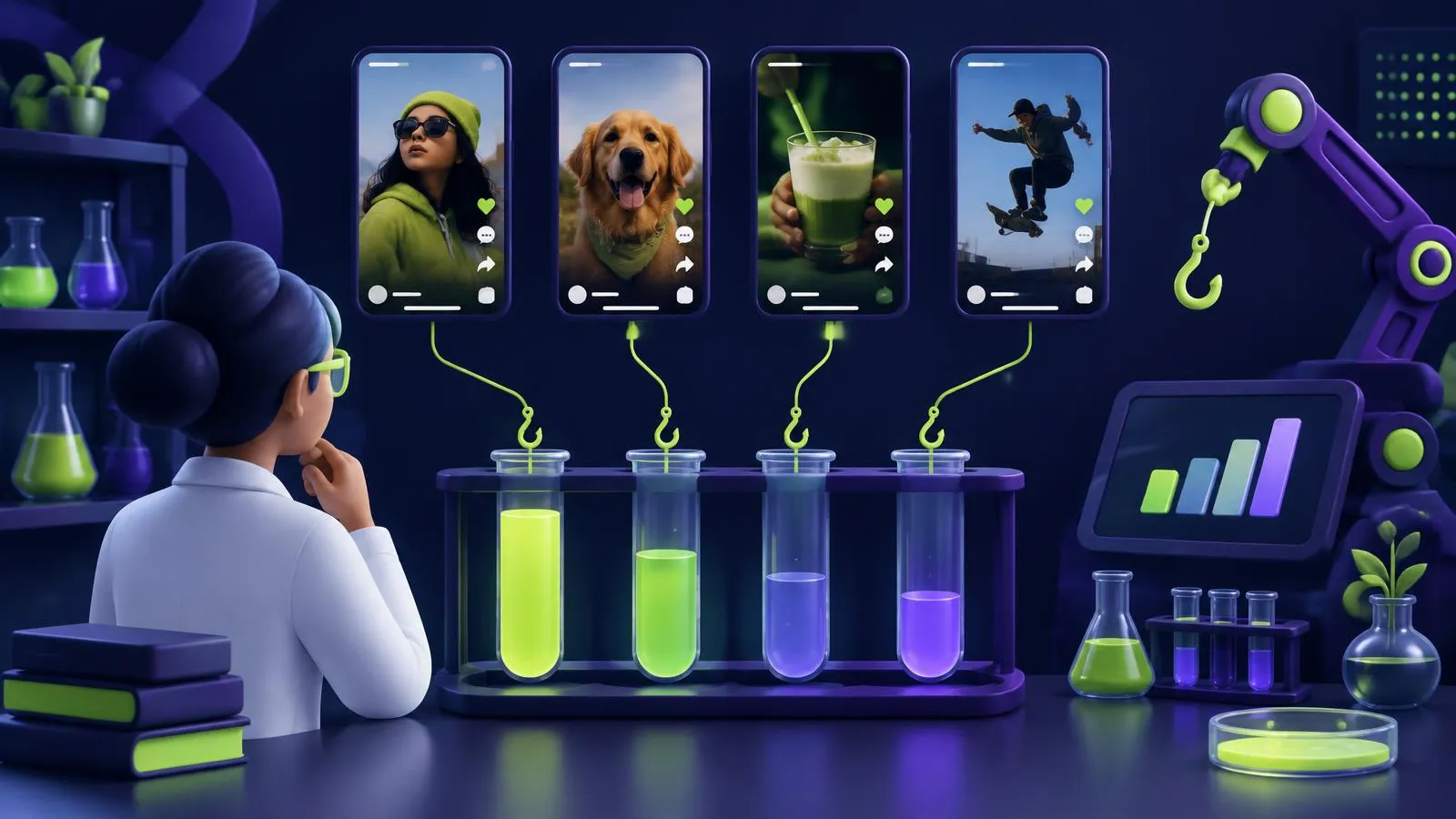
Create a small hook matrix before filming. One version may open with the problem, another with the product in use, and another with a common buyer question. Avoid changing all the remaining scenes at the same time if the purpose is to learn about the opening. Keep claims accurate, and do not turn illustrative footage into an implied customer result.
Define useful evidence before launch
Select a primary outcome close enough to the commercial objective to guide a decision, such as qualified enquiries or confirmed purchases where measurement supports them. Use attention, clicks, landing-page behavior, and cost as supporting signals. If only early indicators are available, label the conclusion provisional rather than presenting them as sales impact.
Optimizely's guidance on primary, secondary, and monitoring metrics explains why an experiment benefits from a clear outcome and supporting checks. Decide in advance what evidence would justify iteration, continuation, or an inconclusive result. Avoid declaring a winner from an arbitrary early fluctuation.
Complete a blank controlled-comparison brief
Record the buyer question, supported product claim, variable under review, shared demonstration, offer and destination. Leave the creative treatment unfilled until the team selects it from verified product information and actual audience questions. Do not create an imagined customer problem to justify a preferred visual concept.
Specify which elements remain stable and which implementation differences would make the comparison difficult to interpret. Confirm that both versions represent the same capability and next step. Obtain approval for Arabic wording and any conditions that must remain visible in the demonstration.
Use separate fields for attention signals, relevant enquiries, understood use case and reviewed sales outcome. Enter observations only after collection, and preserve uncertainty when exposure or review is incomplete. Before revising the opening, inspect whether the destination and offer still match it. The brief should define what evidence would support a creative decision without preassigning a winner or predicting a lift.
Give production an operating memory
Use filenames and a test log that identify the hypothesis, hook, proof, and version. Preserve the approved script and note edits. A production brief such as the Saudi performance reels framework helps the editor understand what must remain stable.
Common mistakes include comparing different offers as if they were hook tests, adding unsupported testimonials, and replacing everything after one weak reporting period. Before refreshing, distinguish a creative problem from a changed audience mix or broken destination; see creative fatigue diagnosis. For a controlled testing plan grounded in your offer and evidence, contact Kitely with current videos and the decision you need the next test to answer.