- How should service content be organized around customer questions?
- How can distinct page roles and internal links prevent overlapping articles?
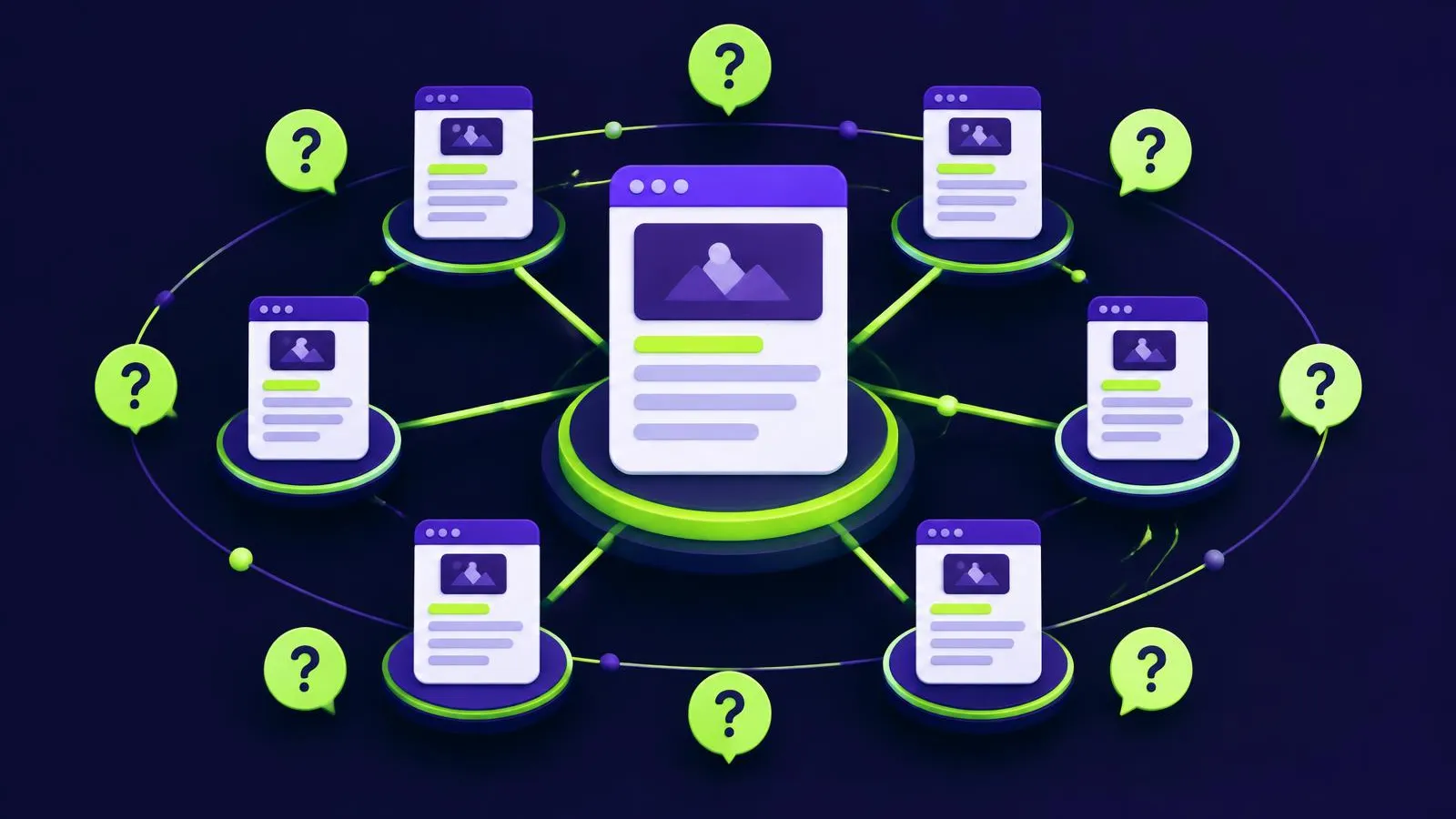
Build a question map before a publishing calendar
A service company in Egypt can publish regularly and still leave buyers unable to compare options. The missing element is often not article volume but a clear relationship between the service offer and the questions that delay an enquiry. A useful content cluster gives each important decision a suitable home.
Collect questions from discovery calls, proposal revisions, account managers and delivery teams. Remove identifying details and ask permission before using client material. Record the buyer's role, the question, the decision it affects and the evidence needed to answer it. Do not treat every keyword variation as a new article opportunity.
Give each page a distinct job
Use a service page to explain the actual offer: scope, process, boundaries, relevant proof and the next action. Use a supporting article when a question requires a deeper explanation that would overwhelm that page. Use a comparison guide when readers need explicit criteria for assessing alternatives.
Google's people-first content guidance emphasizes original, substantial value for readers. Apply that principle by asking what a proposed page adds beyond its neighbours. If only the city name or a service synonym changes, reconsider whether another page is necessary.
A cluster is not a requirement to create a fixed number of articles. It is an editorial structure. Combine overlapping drafts when they answer the same question with the same evidence and lead to the same decision.
Use a four-column planning framework
For every candidate page, record:
- Buyer question: the actual uncertainty expressed in a call or email.
- Distinct intent: understanding the service, preparing for delivery, comparing options or requesting a scope discussion.
- Required evidence: an approved workflow, documented limitation, sample deliverable or expert explanation.
- Useful destination: the next page or action that advances the reader's task.
This framework makes internal linking purposeful. A preparation guide can link to the relevant service scope. A service page can link to a comparison article where buyers need more evaluation detail. Avoid adding every cluster link to every paragraph merely to increase link counts.
A blank page-role and linking map
Collect actual buyer questions from approved sales notes and service documentation. For each question, leave fields for its decision stage, existing answer, proposed page role, evidence owner and relevant next action. Do not assume that every question needs a new URL; check whether an existing page can answer it clearly.
Distinguish service scope, preparation and comparison tasks. The service page explains the offer and its boundaries. A preparation resource helps readers assemble required inputs. A comparison resource applies consistent criteria to supported alternatives. Approve those roles from the questions collected, rather than inventing a provider or repeating the same introduction across pages.
Map each internal link to the task it helps the reader complete. Confirm that linked pages use consistent terminology and approved responsibilities. Keep coverage claims tied to operational evidence, and reject location variants with no distinct useful content. Review the map when scope changes so an informative article does not lead to an outdated service promise.
Review quality before expanding coverage
Common mistakes include publishing a thin article for every phrase, disguising sales copy as an independent comparison, and describing expertise nobody has verified. Another is using location pages that all funnel readers to the same generic destination without meaningful local service information. Avoid that doorway-style pattern; publish a location page only when it answers a genuine, distinct need.
Review enquiries and sales conversations after publication. Did readers arrive with clearer questions? Which explanations still require repeated clarification? Use those observations to update the cluster, not to claim that an article caused a sale. A 90-day growth plan can help sequence this work with other priorities.
To turn scattered buyer questions into a manageable service content system, contact Kitely with your current service pages and a redacted question list.